
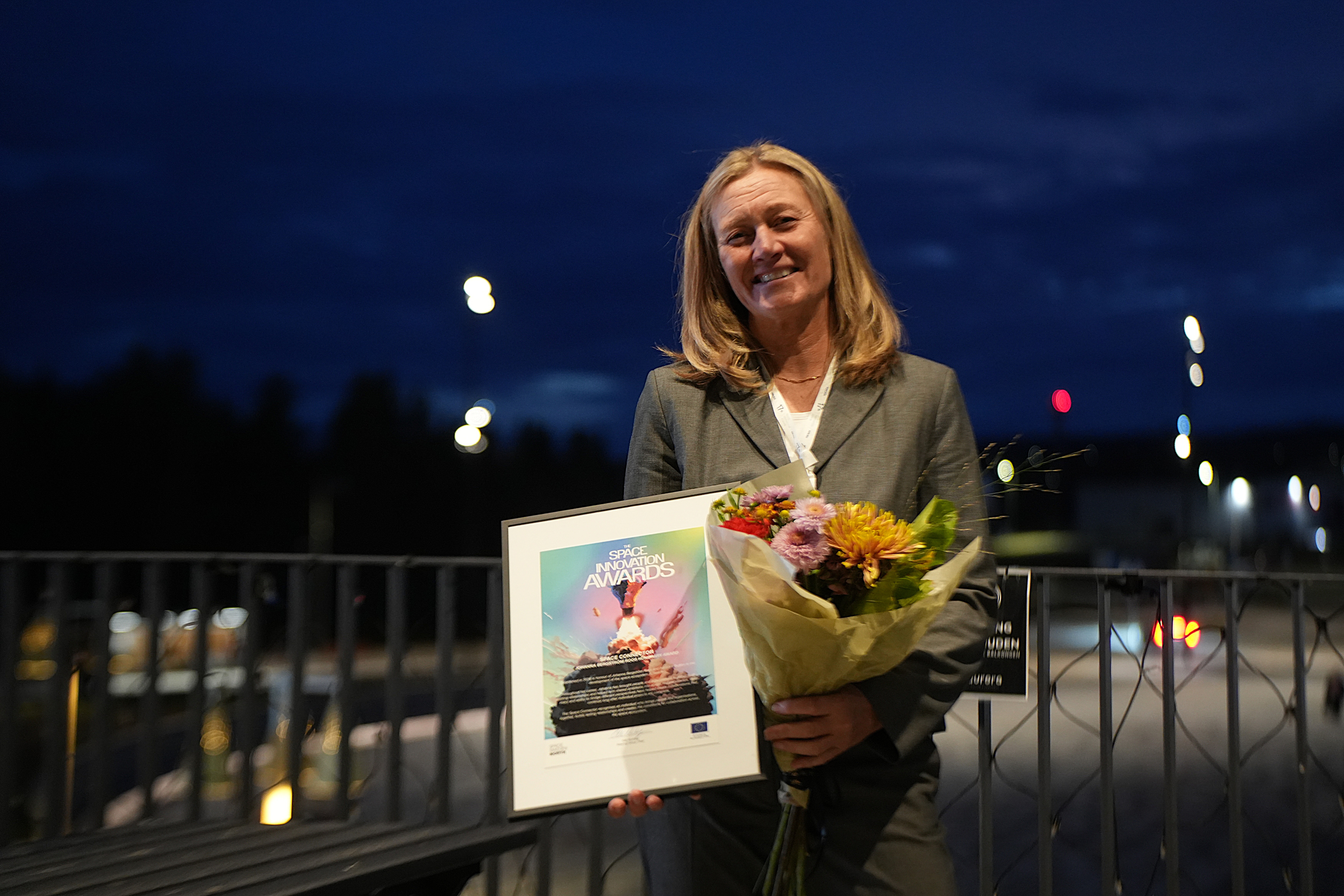
Johanna Bergström Roos, former Project Manager for Space Sweden North. /Simon Vikström, LTU Business
When Johanna Bergström Roos began working with a space cluster focus in northern Sweden in 2015, the region already had many of the ingredients of a world-class space environment. Esrange Space Center, the Swedish Institute of Space Physics, space education and research at Luleå University of Technology, alongside companies and organisations with specialist capabilities, were already firmly established. What was missing was something less tangible, but equally important: stronger connections between them.
Over the past decade, Johanna has been part of building those connections. Through the RIT projects and later Space Sweden North, her work has focused on bringing companies, academia, research organisations and public actors closer together, creating relationships, new formats for collaboration and structures that have helped shape what is today a much more connected regional space ecosystem.
“What I am most proud of is that we have helped create something that is much bigger than any single project,” Johanna says.
As she now hands over the project manager role to Ajith Kumar Baskar, she can look back on a period in which northern Sweden has gone from having a collection of strong individual space actors to being increasingly recognised as an interconnected space ecosystem with national and international relevance.

The original RIT management team back in 2015: Emil Svanberg, Jonas Ekman, Johanna Bergström Roos, Victoria Barabash, Olle Persson, Mate Kerenyi, Johan Kero and Olle Norberg.
Building the connections between the strengths
Johanna describes the development since 2015 as significant. The region’s established strengths remain, world-class space infrastructure, leading research, university education and the unique Arctic environment, but the ecosystem around them has grown. There are more companies and start-ups, closer collaboration between academia and industry and stronger links to national and international networks. At the same time, public actors have gained a greater understanding of the strategic importance of the space sector.
And the definition of what constitutes the space sector has broadened. Space is increasingly connected to entrepreneurship and industrial development, but also to areas such as defence and security, digitalisation, sustainability and regional development.
“I would describe the journey as moving from strong individual assets to a more mature and interconnected innovation ecosystem where the whole value chain is visible as an important strategic asset for Europe.”
For Johanna, one of the achievements she values most is the stronger collective identity that has emerged around northern Sweden as a space region.

Trust is built over time
If there is one thing Johanna has learned from more than a decade of ecosystem development, it is that there are few shortcuts. “Continuity has probably been the single most important factor,” she says.
“Ecosystems are not created through a short project or a few networking events. They are built over many years through repeated interaction, trust and an increasing understanding of what different actors can contribute.”
Much of that work is not necessarily visible from the outside. It means listening to organisations and understanding their different needs, ambitions and challenges. It means recognising when two actors have capabilities that complement each other. And sometimes it means making an introduction that may not lead anywhere immediately but several years later could result in a collaboration, project or business opportunity. For Johanna, curiosity and understanding have therefore been central to her way of working.
“You cannot build collaboration by starting with what you want them to do. You first need to understand their priorities, challenges and ambitions.”
She has also deliberately tried to build relationships that last longer than individual projects. “Projects start and end, while good relationships remain.” It is a quality that Olle Norberg, Director General at the Swedish Institute of Space Physics has seen throughout Johanna’s career. Having followed her work over many years, he highlights her ability to bring together people and organisations that might otherwise never have found each other.

That long-term perspective matters because the actors within a space ecosystem operate under very different conditions. A company might need to see a business opportunity within months, while academic research can span several years and public organisations work within their own political and administrative frameworks.
“A functioning ecosystem therefore needs people and organisations that can translate between those different perspectives.”


Johanna at the 17th Space Innovation Forum. /Simon Vikström, LTU Business
More than networking
Creating places where those different perspectives can meet has been another important part of the work. Over the years, workshops, innovation initiatives, collaborative projects and other activities have created neutral arenas where organisations that might not naturally meet can find common ground. One of the most visible examples is Space Innovation Forum.
What began as an arena for dialogue between regional project partners has developed into a meeting place bringing together speakers and participants from Sweden, the Nordic countries and internationally. In 2026, the 17th edition of Space Innovation Forum was held, a milestone that reflects both the continuity of the initiative and the long-term development of the ecosystem around it. For Johanna, its development reflects how the ecosystem itself has changed.

But she is equally clear that creating an ecosystem cannot stop at bringing people together. “Networking alone is not enough.” There ultimately need to be concrete reasons to collaborate, whether that is new business, customers, technology development, research collaborations, competence, projects or funding.
Space Sweden North as an enabler
That is also how Johanna views the role of Space Sweden North. She describes the cluster primarily as an enabler and connector, rather than an organisation that should try to reproduce capabilities already found among its partners.
“The major capabilities in the ecosystem belong to the companies, universities, research organisations, public actors and space infrastructures themselves.”
The role of Space Sweden North is instead to connect those capabilities: to identify opportunities and gaps, bring actors together, increase the visibility of the ecosystem and create initiatives where organisations can achieve more together than they could individually. “The role of an ecosystem organisation is often not to do everything itself, but to make it easier for others to find each other and make things happen.” Johanna believes that role will remain important as northern Sweden’s space ecosystem enters its next phase.
The next opportunity
Looking ahead, Johanna sees considerable potential in turning more of northern Sweden’s existing strengths into innovation, new companies and business. The combination already present in the region is unusual: space infrastructure, research, education, an Arctic environment and growing industrial activity concentrated within a relatively small geographical area. “Very few regions can combine all of those elements, so we are rather unique.”
She points to opportunities in space technology, downstream applications, Earth observation and data, defence and security, autonomous systems, testing and launch-related activities, as well as connections to the green industrial transition.
But the perspective also needs to extend beyond northern Sweden.

Passing on the role, not the ecosystem
As Ajith now takes over as Project Manager for Space Sweden North, Johanna is clear about the most important advice she wants to pass on.
“Spend a lot of time with the actors in the ecosystem!”
Understanding their different driving forces should come before deciding what the cluster itself should do. “Listen before deciding what Space Sweden North should do. And anchor the next step with relevant actors.” She also encourages him to prioritise. In an ecosystem with many opportunities, there will inevitably be more good ideas than there is time or resources to pursue. At the same time, Johanna does not expect, or want, the next phase to simply replicate what has already been done. “Every phase of an ecosystem needs new ideas and new leadership.”
She hopes Ajith will preserve the long-term perspective and trust developed over the years, while challenging established ways of working and shaping Space Sweden North around a changing space sector. She would also like to see students included even more closely in the ecosystem when relevant. “They are our future.”
For Johanna, stepping away from the project manager role is therefore not a farewell to the space community she has spent more than a decade helping to connect. What she takes with her, above all, is the network. Over the years, she has worked with entrepreneurs, researchers, students, industry leaders, public officials and space organisations from Sweden and abroad. Many professional relationships have also developed into personal ones.
And looking back from 2015 to today gives her a perspective that can be difficult to see while working with long-term development day by day.

Her role will change, but her connection to the ecosystem will remain. Going forward, Johanna will continue to contribute as a senior strategic advisor when her experience and network can be useful, while giving Ajith the space to lead the next phase. “The space ecosystem in northern Sweden is more connected, more visible and more ambitious than it was when we started.” And, as Johanna puts it: “Although I am leaving the role of project manager, I am not leaving the ecosystem.”


First photo: Johanna and Disa at the top of Riksgränsen during the blue hour of polar light in December.Second photo: Heavy snowfall in Vassijaure which bodes well for next day’s summit hike. /private photos
Johanna’s next step in life will include much more of all those fantastic things outside working hours that the Kiruna area offers. Besides spending time with her growing family, including two grandchildren, she has always enjoyed recreation in the nature, especially the mountains. Depending on the season, skiing, hiking, and cycling will most probably fill her days together with reading and learning new things.

